
The manly hormone evolved 500 million years ago — from estrogen.
Testosterone is produced in men’s testicles, women’s ovaries and the adrenal glands of both sexes. In the early weeks of pregnancy, it kicks off the development of reproductive organs for males.
1. Testosterone is produced in men’s testicles, women’s ovaries and the adrenal glands of both sexes. In the early weeks of pregnancy, it kicks off the development of reproductive organs for males.
2. After birth, testosterone plays a role in regulating processes from fat distribution to red blood cell production.
3. Long before the hormone was discovered, people ascribed youth-restoring powers to the testicles. Roman naturalist Pliny the Elder noted the sexually stimulating effects of dining on hyena genitals (with honey, of course).
4. Honeyed hyena testes sound preferable to the handiwork of Kansas huckster John Brinkley, who inserted slices of goat scrotum into men’s testicles in the 1920s, claiming it would boost virility and cure a host of ailments.
7. But testosterone is, relatively speaking, a manly hormone. Normal levels for women are 5 to 7 percent of those for men.
8. Testosterone levels decline with age. Fifty percent of men in their 80s have testosterone levels below the normal adult male range. 9. One thing that’s not declining: demand for testosterone. In 2010, 1.3 million patients in the U.S. received a prescription for the hormone. That number jumped to 2.3 million in 2013.
10. Age isn’t the only cause of low testosterone; obesity is, too. With more body fat, more testosterone gets converted to an estrogen called estradiol, which further inhibits testosterone production.
11. Low T from obesity is a particularly vicious cycle because testosterone builds muscle apparently by stimulating the production of growth hormone releasing hormone (GHRH), which correlates with lean body mass.
12. The hormone was first synthesized in 1935 after initial isolation of another male hormone called androsterone, which was distilled from some 4,000 gallons of donated urine.
13. Dutch researchers coined the term testosterone that same year.
14. There are more than 30 kinds of anabolic-androgenic steroids — the infamous ’roids used and abused to promote muscle growth — but they are all synthetic compounds mimicking testosterone’s chemical structure.
15. There is some correlation between aggressive behavior and testosterone levels, but most research lacks evidence of causation, and some results are contradictory.
16. One study found higher levels of testosterone correlated with aggressive behavior in 12- and 13-year-old boys, but not in 15- and 16-year-old boys. Studies on nonhumans have found much stronger correlations between aggression and testosterone levels.
18. The impact and timing of testosterone production varies greatly among species. For humans, testosterone production kicks in prenatally to differentiate the sexes, but production of testosterone in rats ramps up only after birth.
19. There’s scant evidence to support “natural” testosterone boosters: Elk antler velvet had no lasting effect on T levels, but royal jelly worked wonders — on hamsters.
20. Mixed research results aren’t slowing the testosterone booster bandwagon. In 2013, 25 percent of individuals taking it started treatment without bothering to get a blood test to see if they actually had low T, according to the FDA.

EXERCISE WHILE YOU REST WITH THE CVAC POD
The Cyclic Variations in Adaptive Conditioning (CVAC) pod creates an atmospheric workload, which provides the stressors needed to provoke improvements similar to the effects of aerobic and anaerobic exercise.

Our very own medical advisor, Dr. Deepa Verma, has a CVAC Pod in her office in Clearwater Florida. The CVAC pod may look like it came from space, but it’s actually a breakthrough conditioning technology right here on planet Earth.
As an integrative physician, health nut, and athlete, I am always searching for natural modalities to boost wellness and fitness. A few months prior to opening my integrative practice, I discovered some information concerning a device called the CVAC pod. Aside from looking like it may transport me to the moon, the strange object piqued my curiosity in regards to its potential use in my own life, as well as the lives of my patients.
The Cyclic Variations in Adaptive Conditioning (CVAC) pod creates an atmospheric workload, which provides the stressors needed to provoke improvements similar to the effects of aerobic and anaerobic exercise. What does this mean, exactly? The pod effectively simulates exercise, without the exercise. That doesn’t mean it’s a replacement for your workout (there’s no replacement for sweat), but it can be used in conjunction to help athletes avoid overtraining.
So, how does it work? This high-performance altitude simulator creates changes in temperature, air density, and pressure, ranging from sea level to 22,500 feet above, almost as high as the tallest peak in the Andes mountain range. In essence, it is a hypobaric chamber that prompts the body to compensate for the stressors incurred, which results in conditioning and strengthening of the body from head to toe. It is effective for the same reason athletes who train at high altitude get better workouts, only the effect is compounded: in CVAC, your body is constantly challenged; during a 20-minute session, the altitude changes between 200 and 400 times.
I’ve used the CVAC extensively in my practice, and have worked with everyone from pro athletes to regular Joes. They’ve discussed with me at length what their positive experiences with CVAC were like, but everyone has a slightly different take. Former NFL player and current Saskatchewan Roughrider Clifton Smith summed it up best:
“My experience inside of the CVAC Pod was interesting because I came in not knowing what to expect. I have a case of insomnia and arthritis/tendinitis in my knees. After my first session in the pod, I slept like a baby that night and my energy improved. After a few more sessions, my tendinitis improved during my training to the point that after a few weeks, my trainer said I looked night and day with the cuts I was able to make, and he was really impressed with my athletic ability without a lot of pain. The pod was a great experience in the end because of the improvements I felt in my body and the energy that I had on the field — and running around with my kids.”
Without understanding exactly what’s going on with the pod, the whole thing can feel a little bit like a futuristic tale, so I’ll explain in more detail. Let’s get technical for a second: Time in the CVAC pod makes mitochondria, which are powerhouses of the cell involved in ATP production, more robust, which hastens recovery from muscle injury, biogenesis of new cell growth, and lymphatic drainage and toxin removal. A CVAC session places a natural and tolerable stress on the body by dynamically cycling physical stressors like barostress (pressure), thermostress (temperature) and transient, pulsatile hypoxic stress by changing altitude. The body reacts to that stress by improving cellular function. This, in turn, enhances athletic performance and physical endurance. This same effect occurs during exercise, which can be accompanied by muscle tearing, joint stress, and lactic acid buildup, except CVAC sessions are much easier on the body, and allow an athlete to continue to improve energy production on the days he or she needs to rest to avoid overtraining, according to CVAC founder Carl Linton.
The ability to work out and rest simultaneously is ideal for working through an injury. The pod was instrumental in my work with pro boxer and Rocky Balboa star Antonio Tarver, with whom I used the CVAC pod to help facilitate recovery from a fractured thumb. His regular physician referred him to me for treatments during his recovery period. After several treatments with the pod, Antonio’s X-rays showed accelerated recovery, and his healing time was markedly reduced.
“The CVAC pod’s high-altitude simulator mechanism allowed me to maintain effortless physical conditioning since I couldn’t actively train,” Tarver said, “which allowed me to be victorious in my last fight, complete with a KO in the 7th round.” I couldn’t have been more thrilled to help him achieve it.
While it’s a new technology, the CVAC pod has been shown in early studies to be just as useful as we’ve experienced in my practice. Pilot studies have demonstrated a consistent increase in VO2 max — a measure of the maximum volume of oxygen that an athlete can use — in athletes whose only change in training regimen has been to introduce CVAC sessions. Specifically, in a study at the University of Hawaii, young elite athletes received CVAC Process exposures for eight weeks. After only 40 hours of CVAC exposure, the athletes experienced on average a 5.2 percent increase in VO2 max.
Likewise, an unpublished pilot study out of Stanford University demonstrated the results of four young elite athletes who experienced, at altitude, a 20-percent increase in peak power, a 12-percent increase in blood oxygen saturation, and an 11-percent increase in cardiac output. A validation study performed at the University of Hawaii demonstrated that the challenge created through the transient episodes of lowered oxygen may be the reason CVAC allows the body to become more efficient at utilizing available oxygen.
Closer to home, these studies all match up with my patients’ personal experiences. “Regarding athletic performance, I have thrown over 75 innings the past year with very minimal soreness following each outing,” Jim Kearschner, a patient and Men’s Senior League Baseball Fall Classic Champion, told me. “I have used the CVAC pod before and after games with great results — it helps reduce inflammation in my joints. As a result of great sleep, I have been able to function at high levels and with increased clarity and awareness.”
Athletes aren’t the only ones who can benefit from use of the CVAC pod. Anyone can, especially the deconditioned, and those with certain medical conditions such as diabetes and fibromyalgia. People with obesity, chronic pain, and amputations can have a very difficult time exercising, but CVAC provides the necessary controlled stress that exercise provides to result in cellular and mitochondrial and metabolic efficiency, without the muscle tearing, joint stress, or metabolic waste accumulation found after typical exercise. I have even found CVAC beneficial for patients with asthma and allergies. In fact, it would seem CVAC is well tolerated by just about everybody, from children to the elderly, and there are no contraindications. Additionally, recent evidence shows that the pod may be very beneficial in concussion injuries.
While the pod may look a little intimidating and otherworldly, CVAC technology has been identified as having no significant risk to people by numerous Human Research Protection programs at top universities, including Stanford, UC San Diego, Florida State University, and the University of Hawaii. I really believe that anyone and everyone can use the CVAC pod and gain benefit from it. I call it physical and spiritual reawakening and conditioning — it feels like a dance in the air! Personally, it has improved my sleep and energy levels, and all three of my active boys (ages 5, 7, and 9) use it to improve their athletic performance and recover from muscle overuse during sports. The CVAC is a truly phenomenal tool in my practice, in my own life, and in the larger athletic community.
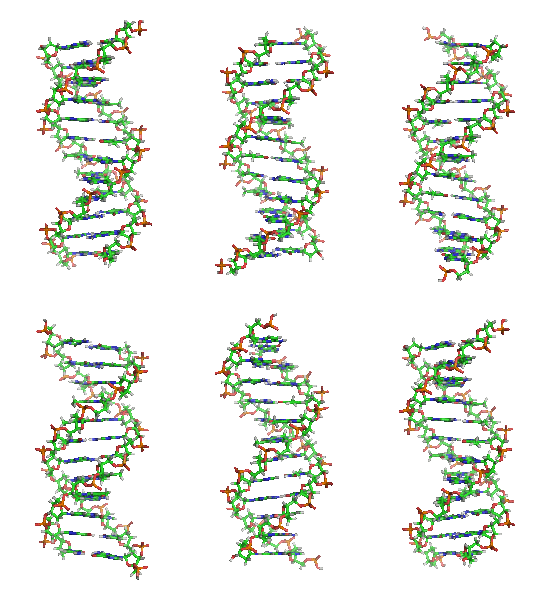
Genetics and Gene Therapy
Genetic Therapy is the use of Genetic Engineering and our knowledge of the Human Genome and those of other species in order to treat chronic diseases and disorders associated with various medical issues.
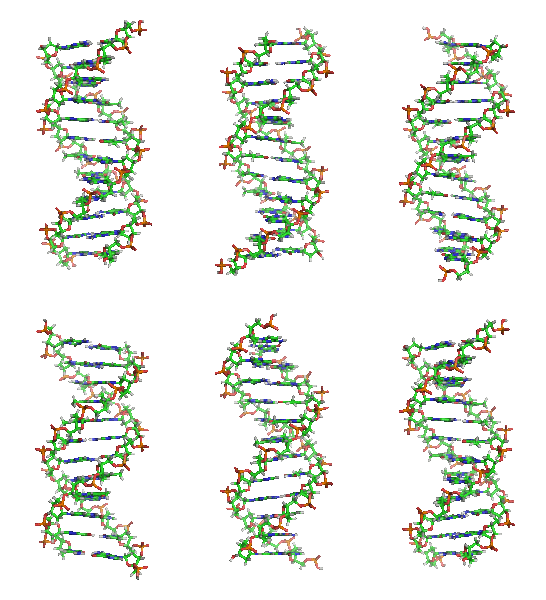
What Are Genes? Genes are the simplest functional components of life on earth. The entire collection of genes in an organism is known as its genetic code, also known as its DNA. The genetic code is a literal blueprint which has the capacity to create an organism.
A gene is a single data-point on a piece of DNA which controls some aspect of the organism. Genes control everything about us via the way that they allow for the creation of proteins and enzymes that are the building blocks of all life forms.
What Are Chromosomes?
Chromosomes make up the next level of genetic organization. All genes are particular aspects of a DNA molecule, and DNA is arranged into helix structures known as chromosomes. All organisms which have a nucleus have a specific number of chromosomes associated with their species which comprises a complete genetic code. There are rare instances where certain organisms have more or less chromosomes that normal, but this represents a mutation, and does not represent the species as a whole.
What is RNA?
RNA is derived from DNA and the genes, and is directly responsible for the production of proteins and enzymes which control the function of the body. The genetic code controls both the metabolic function as well as the structure of each individual cell within an organism.
Reproductive Chromosomes Unique
Sperm and eggs are unique cells within the body, because they only contain split chromosomes. When reproduction occurs, the two sets of half-chromosomes combine, creating an entirely new and randomized set of chromosomes, which has the capacity to create a brand new organism which shares the individual traits of both the mother and the father.
Gene Composition
Molecularly, every gene is comprised of what are known as nucleotides. These nucleotides are the central building blocks of the genes, themselves. All nucleotides are designed in the same way. They contain three components: a phosphoric acid, a sugar, and a compound containing nitrogen. These nucleotides form the double-helix structures which are associated with the DNA molecule.
Importance of Junk DNA
Although a full set of chromosomes contain all of the data needed to completely design an organism, many of the genes within the DNA strands actually do not serve any direct purpose at all. Any DNA Segment that does not contribute to the production of proteins is known as Junk DNA. Junk DNA are scientifically referred to as Introns. All parts of the genetic structure that actually have the capability to create proteins are known as Exons.
Fascinatingly, the vast majority of DNA in the human genetic code is actually junk DNA. Only three percent of the DNA contained within your genetic code actually contribute to your development. Although it sounds like Junk DNA is absolutely worthless, it actually plays a real and significant role in the proper function of the chromosomes.
Every species has a specific number of chromosomes, and each of these chromosomes are organized in the same way. Changing the composition of the genes or the number of chromosomes, causes what is known as a mutation. When these mutations occur in normal cells, it can cause any number of problems. Junk DNA reduces the odds that these mutations occur, while also stabilizing DNA Structure.
What is the Science of Genetics?
Genetics is the scientific study of heredity and inheritance. The term Genotype refers to an organism's specific genetic makeup. Genotype refers to traits as they are expressed in the genetic code.
Phenotype, on the other hand, accounts for what we actually perceive. Phenotype refers to how the genes are ultimately expressed within the organism. The term Genome refers to the full blueprint of the genetic code of a specific species.
What Was the Human Genome Project
Our scientific knowledge of human genetics is incredibly new. The Human Genome was not fully uncovered until 2003. The Human Genome Project was responsible for the mapping of the entire human genetic code. The project was first propodddddsed in 1990 and took thirteen years and three billion dollars to complete. When we completed the blueprint in 2003, what we had was akin to a map without a legend.
Scientists have spent the last decade decoding the blueprint, attempting to discover the purpose of every gene in the genetic code. As researchers and scientists more fully understand the Human Genome, we will be able to take advantage of that knowledge in countless different ways.
What is Genetic Therapy?
Genetic Therapy is the use of Genetic Engineering and our knowledge of the Human Genome and those of other species in order to treat chronic diseases and disorders associated with various medical issues. Because the science of Human Genetics is so new and young, many of these techniques remain in the experimental phase.
At this point, the most complicated aspect of Genetic Therapy is how to appropriately administer the treatment to specific target cells. In order for these forms of treatment to have a powerful and long-lasting effect, they must be delivered to the necessary target so that they can reproduce and propagate among the surrounding tissues. There are two primary means by which Gene Therapy takes place:
Ex Vivo Therapy - In this form of treatment, tissue is extracted from the patient, which is then Genetically Altered and returned to the body. This form of therapy involves either treating human cells after they have been extracted, or altering the cells before returning them to the body.
The most promising research in regard to Ex Vivo Gene Therapy is in regard to neuro-degenerative diseases such as Parkinsons'. One way that scientists have learned to do this is through Ex Vivo Therapy. Defective cells are removed from the patient and fortified with copies which are genetically healthy. After the healthy cells have been given the chance to propagate, they are re-administered to the patient.
In Vivo Therapy - In this form of treatment, therapies which feature Genetically Engineered Medicines are administered directly to the patient. One way to do this in to inject a gene into a non-symptomatic or inactivated virus and let the virus spread the healthy genes to target cells.
Another In Vivo approach is to attach the corrective gene to a liposome so that it may enter the cell through its membrane. Liposomes are microscopic pouches surrounded in fat which have the ability to breach the cell membranes because of their lipid composition.
A third In Vivo approach is known as Chimeraplasty. In this form of Gene Therapy, Bio-Engineered Nucleic Acids are delivered via liposome in order to resolve pathogenic mutations. One way that this form of treatment works is by releasing a chemical that the human body is unable to produce naturally. Another way is by counteracting a pathogenic mutation, correcting it or rendering it inert. A third way that this form of treatment works is by marking cancer cells so that they can be more readily eradicated by other medical treatments.
First Use of Gene Therapy
Gene Therapy is one of the newest medical techniques available to mankind. In human patients, it was first used as a medical treatment in 1990, in order to treat a pediatric patient suffering from Adenosine Deaminase Deficiency.
ADA Deficiency is a significant medical disorder that severely restricts the immune system from functioning, and in some cases, it completely shuts down the Immune System, leaving the patient dangerously exposed to outside pathogens. The future potential for Gene Therapy is incredibly bright. Today, scientists around the world are coming up with new and innovative ways to treat disorders such as AIDS, various genetic disorders, as well as numerous cancers.