

Why You Should Be A Morning Person
What is one thing most successful people have in common? They get up extra early and make the most of the morning. Here’s why:

Originally Posted at: Medium
What is one thing most successful people have in common? They get up extra early and make the most of the morning. Here’s why:
Waking up early gives you time to think before the buzz of the day begins. To put it simply, the early morning is “you time” — a time to lay out your priorities for the day and make progress against them, before others are demanding your time and attention. It puts you firmly in control of each day.
Of course it is awfully hard to get out of bed, but that’s exactly why early risers have the competitive advantage over everyone else. They tackle the day while others hit the snooze button.
Here are just a few examples of ultra-successful early risers:
- Virgin Founder Richard Branson wakes up at 5:45am, even when he’s on his private island, and uses the morning for exercise and breakfast before starting work for the day
- First Lady Michelle Obama starts her day at 4:30am for a workout before her kids wake up
- Apple CEO Tim Cook gets up at 3:45am every day to catch up on email, hit the gym, and make a Starbucks run before heading to the office
- Starbucks CEO Howard Schultz gets up at 4:30am to get a workout in (often a bike ride with his wife) — and of course to make some coffee to get his day going
- Disney CEO Bob Iger rises at 4:30am and uses the early morning to read the paper, exercise, listen to music, catch up on emails, and even watch TV
- Vogue Editor-In-Chief Anna Wintour wakes at 5:45am to play an hour of tennis before work demands hit
- GE CEO Jeff Immelt wakes up at 5:30am and gets in a cardio workout while reading the paper and watching CNBC
Did you notice another consistent trend among all of these ultra-successful people? Everyone’s morning ritual includes exercise as a key component.
In addition to the overall health and fitness benefits, studies have shown that moderate-intensity exercise for 20+ minutes produces a mental and emotional boost for the following 12 hours! This means that these business leaders are likely more clear-headed, effective, and productive at work as a direct result of their morning workout. The exercise time also allows them to think and problem-solve without interruption, so they hit the ground running once they get into the office. Morning exercise is an incredibly efficient use of time.
In addition to waking up extra early and exercising, here are a few more morning habits to get your day moving in the right direction:
- Drink 16 oz. of Water Upon Waking — Rehydrate after your 7–8 hours of sleep
- Make Your Bed — Making your bed every morning is correlated with better productivity throughout the day
- Eat a Healthy Breakfast — Fuel your body for the demands of the day (led by energy-packed fruits and vegetables)
- Drink 1–2 Cups of Coffee — Give yourself a morning boost while reaping the proven health benefits
- Catch up on the News — Use the quiet time to know what’s happening in the world around you
- Prioritize Your Day — Establish your top priorities and think about how to tackle them
All of this sets you up for success before your “work day” even begins, whatever form that may take for you. Being a morning person isn’t reserved for just C-level execs. Everyone will benefit from implementing these good habits.
Think it’s not possible for you because you need the extra sleep? The experts would say to get to bed earlier the night before to make the early wake-up call tolerable.
These tips and success stories help motivate me to get out of bed when all I want to do is sleep a bit more, and hopefully they also inspire you to make the morning your secret weapon!
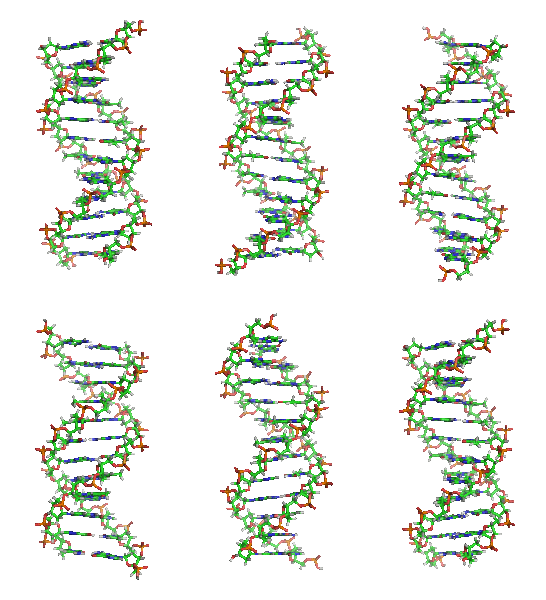
Genetics and Gene Therapy
Genetic Therapy is the use of Genetic Engineering and our knowledge of the Human Genome and those of other species in order to treat chronic diseases and disorders associated with various medical issues.
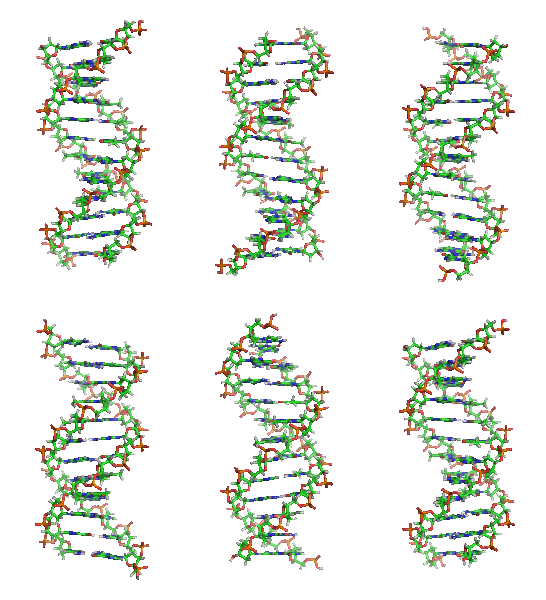
What Are Genes? Genes are the simplest functional components of life on earth. The entire collection of genes in an organism is known as its genetic code, also known as its DNA. The genetic code is a literal blueprint which has the capacity to create an organism.
A gene is a single data-point on a piece of DNA which controls some aspect of the organism. Genes control everything about us via the way that they allow for the creation of proteins and enzymes that are the building blocks of all life forms.
What Are Chromosomes?
Chromosomes make up the next level of genetic organization. All genes are particular aspects of a DNA molecule, and DNA is arranged into helix structures known as chromosomes. All organisms which have a nucleus have a specific number of chromosomes associated with their species which comprises a complete genetic code. There are rare instances where certain organisms have more or less chromosomes that normal, but this represents a mutation, and does not represent the species as a whole.
What is RNA?
RNA is derived from DNA and the genes, and is directly responsible for the production of proteins and enzymes which control the function of the body. The genetic code controls both the metabolic function as well as the structure of each individual cell within an organism.
Reproductive Chromosomes Unique
Sperm and eggs are unique cells within the body, because they only contain split chromosomes. When reproduction occurs, the two sets of half-chromosomes combine, creating an entirely new and randomized set of chromosomes, which has the capacity to create a brand new organism which shares the individual traits of both the mother and the father.
Gene Composition
Molecularly, every gene is comprised of what are known as nucleotides. These nucleotides are the central building blocks of the genes, themselves. All nucleotides are designed in the same way. They contain three components: a phosphoric acid, a sugar, and a compound containing nitrogen. These nucleotides form the double-helix structures which are associated with the DNA molecule.
Importance of Junk DNA
Although a full set of chromosomes contain all of the data needed to completely design an organism, many of the genes within the DNA strands actually do not serve any direct purpose at all. Any DNA Segment that does not contribute to the production of proteins is known as Junk DNA. Junk DNA are scientifically referred to as Introns. All parts of the genetic structure that actually have the capability to create proteins are known as Exons.
Fascinatingly, the vast majority of DNA in the human genetic code is actually junk DNA. Only three percent of the DNA contained within your genetic code actually contribute to your development. Although it sounds like Junk DNA is absolutely worthless, it actually plays a real and significant role in the proper function of the chromosomes.
Every species has a specific number of chromosomes, and each of these chromosomes are organized in the same way. Changing the composition of the genes or the number of chromosomes, causes what is known as a mutation. When these mutations occur in normal cells, it can cause any number of problems. Junk DNA reduces the odds that these mutations occur, while also stabilizing DNA Structure.
What is the Science of Genetics?
Genetics is the scientific study of heredity and inheritance. The term Genotype refers to an organism's specific genetic makeup. Genotype refers to traits as they are expressed in the genetic code.
Phenotype, on the other hand, accounts for what we actually perceive. Phenotype refers to how the genes are ultimately expressed within the organism. The term Genome refers to the full blueprint of the genetic code of a specific species.
What Was the Human Genome Project
Our scientific knowledge of human genetics is incredibly new. The Human Genome was not fully uncovered until 2003. The Human Genome Project was responsible for the mapping of the entire human genetic code. The project was first propodddddsed in 1990 and took thirteen years and three billion dollars to complete. When we completed the blueprint in 2003, what we had was akin to a map without a legend.
Scientists have spent the last decade decoding the blueprint, attempting to discover the purpose of every gene in the genetic code. As researchers and scientists more fully understand the Human Genome, we will be able to take advantage of that knowledge in countless different ways.
What is Genetic Therapy?
Genetic Therapy is the use of Genetic Engineering and our knowledge of the Human Genome and those of other species in order to treat chronic diseases and disorders associated with various medical issues. Because the science of Human Genetics is so new and young, many of these techniques remain in the experimental phase.
At this point, the most complicated aspect of Genetic Therapy is how to appropriately administer the treatment to specific target cells. In order for these forms of treatment to have a powerful and long-lasting effect, they must be delivered to the necessary target so that they can reproduce and propagate among the surrounding tissues. There are two primary means by which Gene Therapy takes place:
Ex Vivo Therapy - In this form of treatment, tissue is extracted from the patient, which is then Genetically Altered and returned to the body. This form of therapy involves either treating human cells after they have been extracted, or altering the cells before returning them to the body.
The most promising research in regard to Ex Vivo Gene Therapy is in regard to neuro-degenerative diseases such as Parkinsons'. One way that scientists have learned to do this is through Ex Vivo Therapy. Defective cells are removed from the patient and fortified with copies which are genetically healthy. After the healthy cells have been given the chance to propagate, they are re-administered to the patient.
In Vivo Therapy - In this form of treatment, therapies which feature Genetically Engineered Medicines are administered directly to the patient. One way to do this in to inject a gene into a non-symptomatic or inactivated virus and let the virus spread the healthy genes to target cells.
Another In Vivo approach is to attach the corrective gene to a liposome so that it may enter the cell through its membrane. Liposomes are microscopic pouches surrounded in fat which have the ability to breach the cell membranes because of their lipid composition.
A third In Vivo approach is known as Chimeraplasty. In this form of Gene Therapy, Bio-Engineered Nucleic Acids are delivered via liposome in order to resolve pathogenic mutations. One way that this form of treatment works is by releasing a chemical that the human body is unable to produce naturally. Another way is by counteracting a pathogenic mutation, correcting it or rendering it inert. A third way that this form of treatment works is by marking cancer cells so that they can be more readily eradicated by other medical treatments.
First Use of Gene Therapy
Gene Therapy is one of the newest medical techniques available to mankind. In human patients, it was first used as a medical treatment in 1990, in order to treat a pediatric patient suffering from Adenosine Deaminase Deficiency.
ADA Deficiency is a significant medical disorder that severely restricts the immune system from functioning, and in some cases, it completely shuts down the Immune System, leaving the patient dangerously exposed to outside pathogens. The future potential for Gene Therapy is incredibly bright. Today, scientists around the world are coming up with new and innovative ways to treat disorders such as AIDS, various genetic disorders, as well as numerous cancers.
Men’s Hormonal Health: Spotting the Red Flags of Low Testosterone.
Testosterone replacement therapy should be provided for men, according to academics who claim the male menopause is genuine.
Low T is no joke, and most men will face it at some point during their lives. The only question is: what will you do about it? Here’s what to look for and how to know when it’s time to see your doctor. You Have Low Sex Drive
It seems weird that you aren’t interested in sex anymore, right? It might not be that you don’t love your wife. It might be that you have low T. Testosterone is the male sex hormone and, while it has many functions in the body besides helping you achieve and maintain erections, sex is the number 1 function of this hormone.
You should base your changes on a predefined “norm” for you. If it’s normal for you to be sexually aroused several times a day and you’re now only aroused once a week, there’s a problem.
If you’re aroused and having sex 3 times a week and suddenly you go a month without getting an erection, you need to go see your doctor – assuming you haven’t just had a major fight with your wife or your marriage is already on the rocks.
In the latter case, book an appointment with a sex therapist.
You Don’t Have Morning Erections
It’s totally normal to have “morning wood.” In fact, if you don’t have an erection in the morning, something is wrong – way wrong. Since testosterone stimulates a man’s sex drive, it’s also responsible for achieving an erection.
When testosterone levels drop too low, achieving and maintaining an erection is impossible. Other health problems can also influence erectile dysfunction too, but this is a major cause.
You Have Low Semen Volume
It’s hard to tell whether you have low semen volume unless you pop into the doctor’s office and get yourself checked out. You will have to ejaculate into a cup, a lab analyses the output, and you get a nifty printout that you can discuss with your doctor.
There are also blood tests that you can take to corroborate the low semen volume, like FHS (follicle-stimulating hormone) and LH
(luteinizing hormone). Both of these hormones are secreted by the anterior pituitary in response to gonadotropin-releasing hormone (GNRH), which is, in turn, released by your hypothalamus.
In plan English, these are hormones that are responsible for your testosterone production. If your blood levels are too low, it’s time to take a look at why your pituitary and hypothalamus gland aren’t doing their job.
You’re Losing Your Hair
A lot of men lose their hair, and they think that’s it’s a natural part of aging. In some respects, yes that’s true. But, the reason it’s “natural” is because your testosterone levels are plummeting. Ouch.
One of the functions of testosterone is hair production. You could also experience loss of body and facial hair as your testosterone levels drop.
You’re Losing Muscle
Muscle loss is also considered “normal,” but it’s because testosterone levels are going down. The hormone plays a major role in the building and strengthening of muscle. So, if you feel weaker than normal, one of the possible causes is a low testosterone value.
And, going into the weight room might not help. According to the Mayo Clinic, those who do try to reverse the muscle loss through weight lifting find it difficult to do – that’s because you need testosterone to be strong. And, you need to be strong to lift weights and progressively overload your system. And, that progressive overload leads to more muscle.
But, without the proper amount of starting “fuel” (without enough testosterone), you can’t “get off the ground” so to speak.
You Feel Different
Being moody – irritable, depressed, or inexplicably angry at the most mundane of things are all signs of low testosterone. Since the hormone directly impacts mood through various physiological processes, having a high testosterone level is important if you want to feel your best – happy, confident, sexual, and calm-assertive.
Your Lab Values Are Low
Lab values will help corroborate a lot of your feelings and intuitions. Unfortunately, according to the Life Extension Foundation, labs can tell you that you’re within normal physiological ranges when you’re not.
Some research suggests that American men have experienced declining testosterone levels, on average, over the past few decades, making current lab ranges inadequate when it comes to properly assessing proper testosterone levels.
What to do? Rely on lab tests you’ve taken throughout your entire life? Oh, you didn’t get labs done at 20?
Look into what a 20-year old testosterone level should be and use that as a rough guide for you.
If you notice your lab values straying significantly from the reference range of a young person, it’s time to look into the best test booster on the market and sleep regimens that will increase testosterone.
If that doesn’t work, talk to Blueprint Health about TRT (testosterone replacement therapy). TRT is pure testosterone hormone that will replace what your body isn’t making.