Vaginal estrogen linked to improved sexual health for some women
Among women who don’t take hormonal replacement therapy (HRT) after menopause, and even some who do, vaginally applied estrogen may help ease dryness and painful intercourse, a small U.S. study suggests.
Among women who don’t take hormonal replacement therapy (HRT) after menopause, and even some who do, vaginally applied estrogen may help ease dryness and painful intercourse, a small U.S. study suggests. Women were most likely to use the vaginal estrogen if they reported pain during sex, and if they had stopped HRT, the study found.
Among the women who abandoned HRT and never went back, the participants using vaginal estrogen reported significantly higher satisfaction with their sex lives, the study published in Menopause also found.
“We would expect that the women with the most severe symptoms would show the greatest benefit and the group that stopped estrogen/hormone use after the WHI would be expected to develop symptoms and benefited the most,” senior study author Dr. Michelle Warren, of Columbia University Medical Center and the Center for Menopause, Hormonal Disorders and Women’s Health in New York, said by email. Women go through menopause when they stop menstruating, which typically happens between ages 45 and 55. As the ovaries curb production of the hormones estrogen and progesterone in the years leading up to menopause and afterwards, women can experience symptoms ranging from irregular periods and vaginal dryness to mood swings and insomnia.
Vaginal dryness and painful intercourse are symptoms thought to result from atrophy of vaginal tissues because of falling estrogen levels. HRT has been shown to improve these symptoms by rebuilding vaginal walls.
For the study, Warren and colleagues studied vaginal estrogen use and sexual health in 310 women in New York City who were born between 1938 and 1953 and had used HRT for at least five years.
While about 36 percent of women who stopped HRT used vaginal estrogen, so did around 17 percent of women who continued HRT, the study found.
Overall, roughly a quarter of women in the study used vaginal estrogen.
The researchers acknowledge that the study is limited by its small size and the fact that participants were generally healthy, highly educated women with normal weight, so the results may not generalize to other groups.
Even so, the findings suggest that some women may benefit from vaginal estrogen whether or not they use HRT, the authors conclude.
“Vaginal estrogen is safer because very little if any estradiol gets into the blood stream,” Dr. Michael Thomas, a researcher in reproductive endocrinology and infertility at the University of Cincinnati Medical Center, said by email.
Lubricants may help make sex less painful for women after menopause, but this alternative can’t work like estrogen to improve the mucous lining of the vagina and make bleeding and abrasions or tearing less likely during intercourse, added Thomas, who wasn’t involved in the study.
BP Health Lab Work and Why We Do Them - Testosterone
Typically, a test for total testosterone is used for diagnosis. The total testosterone test measures testosterone that is bound to proteins in the blood (e.g., albumin and sex-hormone binding globulin [SHBG]) as well as testosterone that is not bound.
Testosterone
How is it used? When is it ordered? What does the test result mean? Is there anything else I should know?
How is it used?
Testosterone testing is used to diagnose several conditions in men, women, girls, and boys. Examples of some of these conditions include:
- Delayed or precocious (early) puberty in boys
- Decreased sex drive in men and women
- Erectile dysfunction in men
- Infertility in men and women
- Testicular tumors in men
- Hypothalamus or pituitary disorders
- Hirsutism and virilization in girls and women
When is it ordered?
In boys with delayed or slowly progressing puberty, the test is often ordered with the FSH and LH tests. Although there are differences from individual to individual as to when puberty begins, it is generally by the age of 10 years. Some symptoms of delayed puberty may include:
- Delayed development of muscle mass
- Lack of deepening of the voice or growth of body hair
- Slow or delayed growth of testicles and penis
In men, the test may be ordered when infertility is suspected or when a man has a decreased sex drive or erectile dysfunction. Some other symptoms include lack of beard and body hair, decreased muscle mass, and development of breast tissue (gynecomastia). Low levels of total and bioavailable testosterone have also been associated with a greater presence of visceral fat (midriff or organ fat), insulin resistance, and increased risk of coronary artery disease.
In females, testosterone testing may be done when a woman has irregular or no menstrual periods (amenorrhea), is having difficulty getting pregnant, or appears to have masculine features, such as excessive facial and body hair, male pattern baldness, and/or a low voice. Testosterone levels can rise because of tumors that develop in either the ovary or adrenal glandor because of other conditions, such as polycystic ovarian syndrome (PCOS).
What does the test result mean?
Males: The normal range for testosterone levels in men is broad and varies by stage of maturity and age. It is normal for testosterone levels to slowly decline starting in the third decade of life. The rate may increase in men who are obese or chronically ill and with the use of certain medications.
A low testosterone level (hypogonadism) may be due to:
- Hypothalamic or pituitary disease
- Genetic diseases that can cause decreased testosterone production in young men (Klinefelter, Kallman, and Prader-Willi syndromes) or testicular failure and infertility (as in myotonic dystrophy, a form of muscular dystrophy)
- Impaired testosterone production because of acquired damage to the testes, such as from alcoholism, physical injury, orviral diseases like mumps
- Testicular tumors
- Adrenal tumors that are producing testosterone
- Use of androgens (also called anabolic steroids)
- Early puberty of unknown cause in boys
- Hyperthyroidism
- Congenital adrenal hyperplasia
- PCOS
- Ovarian or adrenal gland tumor
- Congenital adrenocortical hyperplasia
Is there anything else I should know?
Alcoholism and liver disease in males can decrease testosterone levels. Drugs, including androgens and steroids, can also decrease testosterone levels.
Prostate cancer responds to androgens, so many men with advanced prostate cancer receive drugs that lower testosterone levels.
Drugs such as anticonvulsants, barbiturates, and clomiphene can cause testosterone levels to rise. Women taking estrogen therapy may have increased testosterone levels.
Hormone Tests for Women
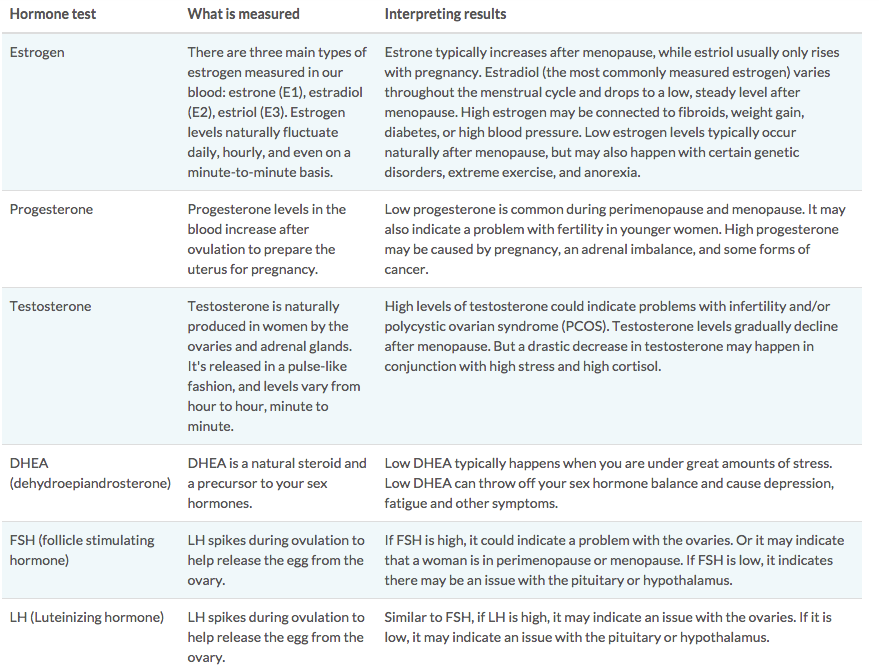
Here's a general overview of the basic hormone tests and what they mean to your health and hormonal balance. When is hormone testing helpful? By dividing women into three generalized groups it will help you understand who benefits from hormone testing and who may not.
Modern medicine has led us to believe that, for most medical issues, there's a single test that will confirm a clear and concise diagnosis. This is about as helpful as a 6-minute doctor visit, and springs from the same limited thinking. Women are especially hurt by this kind of medical approach to hormonal imbalance. That's because hormone panels and other tests aren't as helpful as you might wish. But in the hands of a skilled doctor who will take the time to "connect the dots", the tests can be very meaningful. Here's a general overview of the basic hormone tests and what they mean to your health and hormonal balance. When is hormone testing helpful? By dividing women into three generalized groups it will help you understand who benefits from hormone testing and who may not.
Women with fertility issues. For women in this category, hormone panels are key, both as a diagnostic and a therapeutic tool. So many fertility problems can be traced to irregularities in the menstrual cycle, and your practitioner needs to understand what's wrong in order to give you the right support.
Women with ordinary symptoms of hormonal imbalance. Women often ask us: is there a test to tell whether I'm in menopause? The short answer is no. You're menopausal when you haven't had a period for a year. Hormone tests are not required for this largest group of women. The symptom patterns are very individual, but the first line therapy is mostly the same: build a nutritional foundation, take the right basic supplements to restore balance, and make meaningful lifestyle changes.
Women with severe symptoms of hormonal imbalance. For women with debilitating or intractable symptoms, a hormone panel is essential. When dealing with PCOS, fibroids, diagnosed alopecia (hair loss), and other more severe hormone issues, your practitioner simply can't treat you without knowing where your hormones are.
Key tests in a hormone panel When it comes to key tests in a hormone panel, what they measure and what the results mean, levels and ranges will vary from lab to lab. This chart gives you a very general idea of what high or low levels of a particular hormone may indicate.